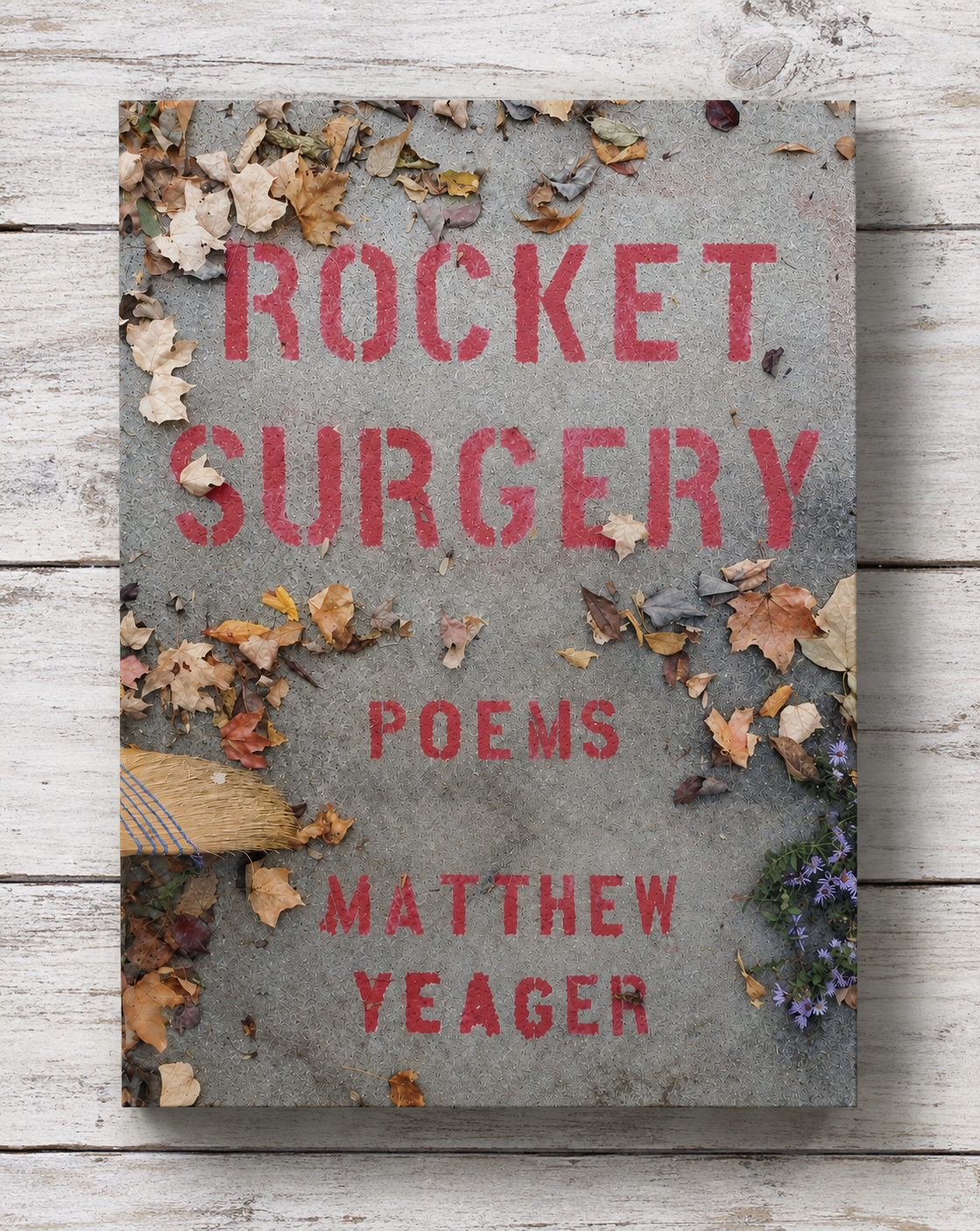
Matthew Yeager’s Rocket Surgery is masterfully composed, intellectually dazzling, sharply observed, emotionally intimate, morally serious, and playfully comic. Its shifting tones and refracted voices are fully alive and presented to utmost dramatic effect. The volume's combined sense of sound, sight, taste, smell, and touch complexly equals James Joyce’s various epiphanic versions of St. Ignatius of Loyola’s Spiritual Exercises. At the heart of Yeager’s magnificent poetic credo is complete and utterly envisioned light.
—Lawrence Joseph, author of A Certain Clarity: Selected Poems
I've long regarded Matthew Yeager as a kind of modern-day Kenneth Koch. Like Koch, Yeager writes long poems brimming with wit and keen observation. Rocket Surgery includes it all, from New York City graffiti to a pair of footy socks, from Anna Nicole Smith to Rainer Maria Rilke. Yeager’s voice is utterly unique—charming, hilarious, and refreshingly self-aware. (Also, his similes! Oh, how I adore a Yeager simile!) Inside these smart and rapturous poems, I learned so much about poetry, art, and about my own impermanence, but most of all, I had a rocking good time.
—Marianne Chan, author of All Heathens
Matthew Yeager's poems are alive and wild and fun like being picked up by a swarm of bees and carried safely across a river. I never exactly expect the next line of his poems or what golden story he might tell that I absolutely needed to hear….His imagination is absolutely feral.
— Steve Scafidi, author of The Appalachian Sea
Rocket Surgery is a thoughtful, often riveting engagement with the effects of place on character…a sort of poppier, working-class Self Portrait in a Convex Mirror mixed with the wildness of the Forklift, Ohio School. As in the former, Yeager’s poems depend for their success on the muscularity of the mind in action, engaging in efforts of observation and intellect that hold a reader’s attention across the book’s 156 pages.
— from Christopher Kempf’s review in Preposition
For the limited attention spans of kids these days (and adults) inured to their devices, this book throws down its gauntlet, refuting Hamlet’s maxim “that brevity is the soul of wit.” Strangely and strongly enough, each poem manages to supply ample wit on every page. Each of Yeager’s extended forays into foreplay take the art of poetic edging to new lyrical heights….What a romp this book is. Never again will one’s appetite for Rilke be caught in this explicit and exacting way: “Interiority. In Letters to a Young Poet, / that’s what Rilke is stressing on practically every page. / He’s telling this kid, over and over to be inward, to grow inwardly, / to eat the donuts of solitude until your pants / shoot a button. Then keep eating! Eat like it’s a contest!”
— from Timothy Liu’s review in Plume